
Saint Or Swindler?

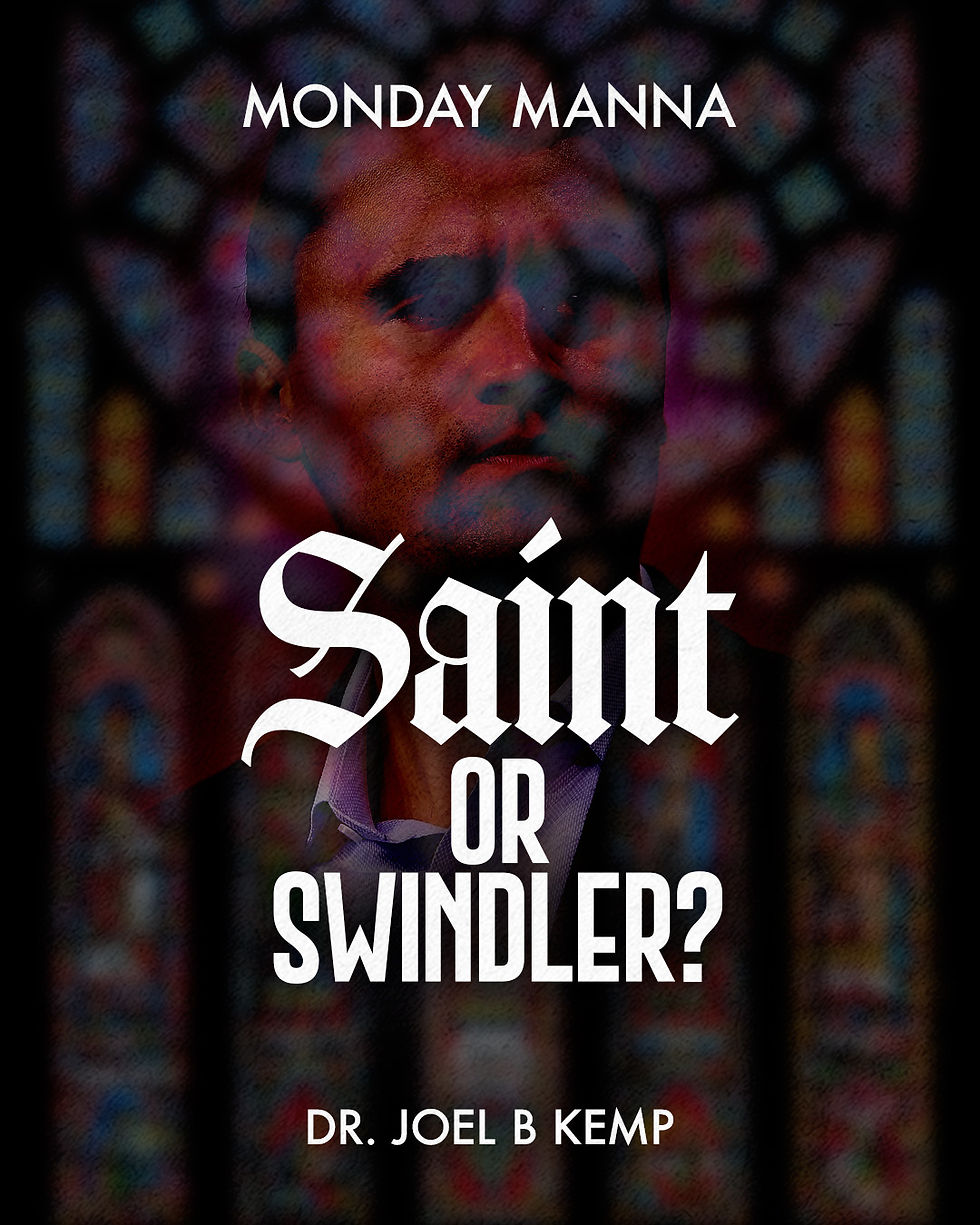
The murder of Charlie Kirk follows the deaths of other prominent conservative voices, notably John MacArthur and James Dobson. For some, Kirk was a modern day American prophet. He declared the uncomfortable truths necessary for a nation to survive – a “pied piper” for a new generation of American conservatism. For others, he was the modern mouthpiece of an ancient evil – an evil rooted in the lie of white supremacy that demonizes all who fail to fit into a narrow definition of what it means to be an American.
While many continue to reflect on the controversial legacies Kirk and these men leave behind, the sudden end to Kirk’s life provides an opportunity to observe the continuation of another American tradition. Our nation habitually rebrands the unconscionable, sanctifies the reprehensible, and justifies the abominable. Too often, the rebranding, sanctifying, and justifying relies upon a virulent strand of American Christianity rooted more in the lie, myths, and narratives of white supremacy than in solid biblical exegesis or informed theological reflection.
The range of reactions to Kirk’s end provides a real-time glimpse into this rebranding process. By labeling his death an assassination, it imbues him and his “teachings” with a national significance comparable to individuals like President Abraham Lincoln, Dr. Martin Luther King, Jr., and President John F. Kennedy. Moreover, including him among a list of American martyrs legitimizes his teachings as part of the American gospel – a theo-political canon that should reshape generations of American citizens.
A strange fruit of this process is the purported threats against Historically Black Colleges and Universities (HBCUs). Several have raised the question: “how are Black folk being blamed for this one?” Early reports indicate a white man is accused of killing another white man – another example of white-on-white crime. Kirk was killed in a predominately white state (Utah has a white population some estimate between 75 – 81%) at a predominately white institution. Black folk literally had nothing to do with it. So, the question remains: “how did HBCUs become targets?”
A partial answer to this question is how the American story portrays the relationship between whiteness and blackness. Our national drama has cast white individuals (who embody whiteness) as the bearers of virtue and civilization – the ultimate hero. In contrast, black individuals are branded as the quintessential other and perpetual threat – the ultimate villain. This simple binary of white/good vs. black/evil is triggered easily when narratives of “us” vs. “them” arise. In some communities, Kirk is being cast as an evangelist of whiteness – a courageous proclaimer of truth, justice, and the American way. Since the national script tells us the enemy of whiteness is blackness, then black people (who embody blackness) must be guilty. Thus, the reflex of the lie of white supremacy gains “righteous rationalization” by appealing to the narrative of the white, virtuous martyr assassinated by the un-American and un-godly villain. Within this American narrative, the role of the villain defaults to those who embody blackness, even if the killer is white.
History makes our heroes. Whether Kirk is finally valorized or villainized will say more about who this nation chooses to be and less about who he was.


Wow Dr. Kemp! That’ll preach. This piece offers so much insight into the direction of our nation. I have not thought much about Kirk’s death, but this manna has raised my awareness and highten my vigilance when it comes to people attempting to engage in discussion of the matter. Thank you!
"Saint or Swindler?" The use of descriptions of such stark contrasts really helped me clarify the issues and what is at stake. Additionally, the clearly articulated process used to reframe facts into myths, lies, and other distortions is most helpful in understanding how people arrive at conclusions so contrary to actual events-. That is "rebrand[ing] the unconscionable, sanctify[ing] the reprehensible, and justify[ing] the abominable." We see this happening over and over again throughout history. Thank you, Dr. Kemp, for helping clarify the what and how of what's happening in this country so we can better chose and articulate the basis of our agreement or opposition.